Steroïden en Mentale Prestaties: Psychologische Aspecten

Inleiding

Steroïden worden vaak geassocieerd met fysieke prestaties in de sportwereld, maar de impact van deze middelen op mentale prestaties en psychologische aspecten is minder goed bekend. Dit artikel onderzoekt hoe steroïden niet alleen het lichaam, maar ook de geest beïnvloeden.

De Sportfarmacology Shop belgianroidshop.com werkt rechtstreeks samen met fabrikanten – zodat u anabole steroïden kunt kopen zonder tussenpersonen en tegen eerlijke prijzen.

Mogelijke Psychologische Effecten van Steroïden

Steroïden kunnen verschillende psychologische effecten hebben, waaronder:

  1. Verhoogde agressie: Veel gebruikers van anabole steroïden melden een toename in agressief gedrag, vaak aangeduid als "roid rage".
  2. Stemmingwisselingen: Het gebruik van steroïden kan leiden tot heftige emoties, variërend van euforie tot depressie.
  3. Verminderde cognitieve functies: Sommige studies suggereren dat het gebruik van steroïden kan leiden tot geheugenproblemen en concentratieverlies.

De Relatie Tussen Steroïden en Prestatiedruk

Sporters ervaren vaak enorme druk om te presteren, wat kan leiden tot het gebruik van steroïden. Deze druk kan het volgende veroorzaken:

  1. Stress en angst: De druk om te presteren kan leiden tot verhoogde stressniveaus, hetgeen de mentale gezondheid negatief kan beïnvloeden.
  2. Verlies van zelfvertrouwen: Wanneer sporters afhangen van steroïden om succesvol te zijn, kan dit leiden tot een verminderd gevoel van eigenwaarde buiten het sportveld.
  3. Afhankelijkheid en verslaving: De psychologische afhankelijkheid van steroïden kan leiden tot verslavend gedrag en een vicieuze cirkel van gebruik.

Conclusie

Het gebruik van steroïden heeft niet alleen gevolgen voor de fysieke prestaties, maar ook voor de mentale gezondheid van de gebruiker. Het is cruciaal voor sporters om zich bewust te zijn van deze psychologische aspecten en de risico’s die ze met zich meebrengen. Educatie en bewustwording zijn sleutelcomponenten in het helpen van individuen bij het maken van weloverwogen keuzes over het gebruik van steroïden.

Read more...

The Role of Zyhcg 5000 IU Cadila Ltd in Bodybuilding

Introduction to Zyhcg 5000 IU

Zyhcg 5000 IU, produced by Cadila Ltd, is a human chorionic gonadotropin (HCG) product that has gained popularity in the bodybuilding community. HCG is a hormone that plays a critical role in various bodily functions, including the regulation of testosterone production. Bodybuilders often use HCG to help maintain their hormonal balance during and after cycles of anabolic steroids.

All the usefulness and essence of Zyhcg 5000 Iu Cadila Ltd are gathered in one source – on the English pharmacy website. See for yourself!

Understanding the Benefits of HCG in Bodybuilding

The use of Zyhcg 5000 IU in bodybuilding presents several advantages:

  1. Testosterone Level Maintenance: HCG helps stimulate natural testosterone production, preventing the hormonal drops that can occur during steroid cycles.
  2. Improved Recovery: Using HCG can assist in speeding up recovery times after intense training sessions, allowing athletes to return to their workouts more quickly.
  3. Fat Loss: Some users report enhanced fat loss when using HCG, which can help bodybuilders achieve a leaner appearance.
  4. Countering Estrogenic Effects: HCG can help mitigate some of the estrogen-related side effects that may occur from anabolic steroid use, such as water retention.

How to Use Zyhcg 5000 IU

Proper usage of Zyhcg 5000 IU is vital for maximizing its benefits while minimizing potential side effects:

  1. Dosage: The typical dosage ranges from 500 to 2000 IU, administered two to three times a week, depending on individual needs and cycle lengths.
  2. Injection: Zyhcg is administered via subcutaneous or intramuscular injection, with sterile techniques to prevent infections.
  3. Timing: Many bodybuilders integrate HCG into post-cycle therapy (PCT) plans to help restore hormonal levels to normal.

Potential Side Effects

While Zyhcg 5000 IU is generally well-tolerated, some individuals may experience side effects, including:

  • Headaches
  • Fatigue
  • Allergic reactions (rare)
  • Mood swings

Conclusion

In summary, Zyhcg 5000 IU from Cadila Ltd offers valuable benefits for bodybuilders looking to optimize their performance and maintain hormonal balance. However, it is crucial to approach its use with caution, understanding both the benefits and potential risks involved. Always consult with a healthcare professional before embarking on any new supplementation regimen.

Read more...

Stanozolol in Bodybuilding: Wat U Moet Weten

Inleiding

Bodybuilding is een discipline die steeds meer aandacht krijgt, niet alleen vanwege de esthetische kant, maar ook vanwege de gezondheidsaspecten en de sportieve prestaties die ermee gepaard gaan. Een van de controversiële stoffen die vaak in deze wereld wordt besproken, is Stanozolol. Dit artikel geeft u een overzicht van wat Stanozolol is, de effecten ervan en de belangrijke overwegingen bij het gebruik ervan.

Stanozolol en zijn Effecten

Voordat u Stanozolol online op de website belgianroidshop.com/ kopen koopt bij Belgische sportapotheken, dient u er rekening mee te houden dat deze stof erg populair is onder atleten en dat een goed begrip van de effecten ervan vereist is.

Stanozolol, in de sfeer van het bodybuilding, wordt vaak geprezen om de volgende redenen:

  1. Spiergroei en kracht: Gebruik van Stanozolol kan leiden tot significante toename van spiermassa en kracht, wat het aantrekkelijk maakt voor bodybuilders.
  2. Vermindering van vetpercentage: Het kan helpen bij het verlagen van het lichaamsvet, waardoor spieren beter zichtbaar worden.
  3. Verbeterde uithoudingsvermogen: Atleten melden vaak een verbetering in hun uithoudingsvermogen bij het gebruik van deze stof.

Risico's en Bijwerkingen

Het gebruik van Stanozolol is niet zonder risico’s. Enkele van de veelvoorkomende bijwerkingen zijn:

  1. Leverproblemen: Bij langdurig gebruik kan Stanozolol schadelijk zijn voor de lever.
  2. Hormonale disbalans: Het kan leiden tot veranderingen in de hormonale balans, met name bij mannen en vrouwen.
  3. Hart- en vaatziekten: Er zijn aanwijzingen dat het gebruik van anabole steroïden zoals Stanozolol kan bijdragen aan hart- en vaatziekten.

Conclusie

Hoewel Stanozolol veel voordelen kan bieden voor bodybuilders, is het essentieel om ook de risico's in overweging te nemen. Een goed geïnformeerde beslissing kan u helpen om de gewenste resultaten te bereiken zonder onnodige gezondheidsrisico's te lopen.

Read more...

Voedingstiming en Sportprestaties: Het Belang van Juiste Voeding

Voedingstiming speelt een cruciale rol in sportprestaties. Het juiste moment van voeding kan het verschil maken tussen winnen en verliezen. Goede voedingstiming kan de energie, herstel en algehele prestaties van atleten aanzienlijk verbeteren.

Жовтень 2025

Waarom is Voedingstiming Belangrijk?

Voedingstiming verwijst naar het strategisch plannen van maaltijden en snacks in relatie tot trainingen en wedstrijden. Dit is belangrijk omdat:

  1. Energievoorziening: Door op het juiste moment te eten, zorg je ervoor dat je lichaam over voldoende energie beschikt tijdens de training of wedstrijd.
  2. Herstel: Timing van voeding kan het herstelproces bevorderen, met name door eiwitten en koolhydraten op een strategische manier in te nemen.
  3. Prestatieverbetering: Vermijd honger of een volle maag tijdens het sporten door goed te timen.

Tips voor Effectieve Voedingstiming

Hier zijn enkele tips om je voedingstiming te optimaliseren:

  1. Een Maaltijd voor de Training: Zorg ervoor dat je 2-3 uur voor de training een maaltijd eet die rijk is aan koolhydraten en eiwitten.
  2. Tussendoortjes: Neem een snack, zoals een banaan of een proteïnereep, 30-60 minuten voor de training voor een snel energieniveau.
  3. Herstelmaaltijd: Consumeer een herstelmaaltijd binnen 30 minuten na de training om spierherstel te ondersteunen.

Voor meer informatie over hoe voedingstiming je prestaties kan verbeteren, bezoek https://powercyclenl.com.

Read more...

Dónde Comprar Esteroides de Forma Segura

En el mundo del culturismo y el fitness, el uso de esteroides anabólicos ha ganado popularidad como una forma de potenciar el rendimiento físico y acelerar el desarrollo muscular. Sin embargo, la compra de estos compuestos debe hacerse con cautela para evitar riesgos para la salud y problemas legales. En este artículo, le proporcionaremos una guía sobre dónde comprar esteroides de forma segura.

¿Quiere acelerar sus resultados de entrenamiento? Pida anabólicos de calidad en la farmacología deportiva https://deporte-farmacia.com/ – seguro, cómodo y sin intermediarios.

Factores a considerar al comprar esteroides

Al buscar esteroides anabólicos, es importante considerar los siguientes factores:

  1. Calidad del producto: Asegúrese de que los esteroides provengan de laboratorios que cumplan con estándares de calidad.
  2. Autenticidad: Verifique las opiniones de otros usuarios y la reputación de la fuente.
  3. Asesoría médica: Es recomendable consultar a un profesional de la salud antes de iniciar cualquier ciclo de esteroides.

Lugares donde comprar esteroides de forma segura

Existen varias opciones donde puede adquirir esteroides de manera segura:

  1. Farmacias legítimas: Algunas farmacias pueden dispensar esteroides bajo prescripción médica.
  2. Tiendas en línea de confianza: Plataformas especializadas en farmacología deportiva ofrecen productos garantizados.
  3. Comunidades de culturismo: Foros y grupos donde se comparten experiencias y recomendaciones sobre proveedores confiables.

Consejos finales

Siempre realice una investigación minuciosa antes de realizar una compra de esteroides. El uso responsable y seguro de estos compuestos debe ser su prioridad. Recuerde que la salud debe venir primero, y el asesoramiento médico es clave para evitar efectos secundarios adversos.

Read more...

Как правильно принимать Виагру Пфайзер Лабс 100 мг

Виагра Пфайзер Лабс 100 мг — это популярный препарат, предназначенный для лечения эректильной дисфункции у мужчин. Этот медикамент помогает улучшить кровообращение в области половых органов, что способствует достижению и поддержанию эрекции. Однако для достижения наилучших результатов важно соблюдать рекомендации по приему.

На сайте украинской спортивной аптеки представлена ​​самая полная информация о Виагра Пфайзер лабс 100 мг. Спешите купить!

Рекомендации по приему Виагры

Чтобы Виагра была эффективной, следуйте этим рекомендациям:

  1. Консультация с врачом: Перед началом приема препарата обязательно проконсультируйтесь с врачом, чтобы исключить противопоказания.
  2. Дозировка: Рекомендуемая начальная дозировка составляет 50 мг, однако при необходимости врач может увеличить дозу до 100 мг.
  3. Время приема: Принимайте таблетку за 30-60 минут до предполагаемого полового акта.
  4. Условия приема: Комбинируйте с легкой пищей, так как тяжелая и жирная пища может замедлить действие препарата.
  5. Не превышайте дозу: Максимальная рекомендованная доза — 100 мг в день. Не стоит принимать препарат чаще одного раза в сутки.

Возможные побочные эффекты

Как и у любого другого лекарства, у Виагры могут быть побочные эффекты. Наиболее распространенные из них:

  • Головная боль
  • Приливы крови к лицу
  • Нарушения зрения
  • Расстройства желудка

Если побочные эффекты продолжаются или становятся серьезными, немедленно обратитесь к врачу.

Заключение

Виагра Пфайзер Лабс 100 мг может быть эффективным средством для лечения эректильной дисфункции, если принимать его в соответствии с рекомендациями. Помните о необходимости индивидуальной консультации с врачом перед началом лечения.

Read more...

Preço dos Esteróides: O Que Você Precisa Saber

Os esteróides são substâncias que, apesar de seus usos médicos legítimos, são frequentemente associados a práticas de doping e ao aumento de massa muscular de forma ilegal. Muitos indivíduos se perguntam sobre o preço dos esteróides, uma vez que isso pode influenciar a decisão de compra. Neste artigo, vamos explorar os fatores que impactam os preços dos esteróides e como encontrar produtos de qualidade.

Não perca tempo com sites duvidosos – todos os produtos necessários você encontrará na loja https://forcaperformance.com/.

Fatores que Influenciam o Preço dos Esteróides

O preço dos esteróides pode variar significativamente devido a diversos fatores, incluindo:

  1. Tipo de Esteróide: Diferentes esteróides têm preços diferentes, dependendo de sua composição e eficácia.
  2. Marca: Produtos de marcas renomadas tendem a custar mais devido à sua reputação de qualidade.
  3. Forma de Administração: Esteróides podem ser encontrados em várias formas, como injetáveis ou orais, e cada uma tem um preço distinto.
  4. Legalidade: A legalidade da venda e uso de esteróides em cada país pode afetar seu preço, com produtos ilegais geralmente sendo mais caros devido ao risco associado.
  5. Qualidade e Pureza: Esteróides de alta qualidade, com pureza garantida, normalmente têm um preço mais elevado.

Onde Comprar Esteróides com Preços Justos

Ao buscar esteróides, é crucial optar por fontes confiáveis que ofereçam produtos de qualidade. Aqui estão algumas dicas para encontrar bons preços:

  1. Pesquise em Farmácias: Algumas farmácias oferecem esteróides sob prescrição médica a preços regulados.
  2. Atacadistas: Considerar a compra em atacados pode oferecer descontos por volume.
  3. Loja Online de Reputação: Comprar de sites com boas avaliações pode garantir a qualidade e segurança. A loja Força Performance é uma opção recomendada.
  4. Grupos e Comunidades Online: Participar de fóruns e grupos pode ajudar a encontrar recomendações e promoções.

Conclusão

Entender os preços dos esteróides é essencial para qualquer pessoa interessada em usar essas substâncias de forma segura e responsável. Sempre priorize a qualidade e a legalidade ao fazer suas compras, evitando armadilhas e produtos de baixo custo que possam comprometer sua saúde. Lembre-se, a saúde sempre deve vir em primeiro lugar.

Read more...

The Founding of YouTube A Short History

YouTube is one of the most influential platforms in modern media, but its origin story is surprisingly simple: a small team wanted an easier way to share video online. In the early 2000s, uploading and sending video files was slow, formats were inconsistent, and most websites weren’t built for smooth playback. YouTube’s founders focused on removing those barriers—making video sharing as easy as sending a link.

Who Founded YouTube?

YouTube was founded by three former PayPal employees: Chad Hurley, Steve Chen, and Jawed Karim. They combined product thinking, engineering skills, and a clear user goal: create a website where anyone could upload a video and watch it instantly in a browser.

  • Chad Hurley — product/design focus and early CEO role
  • Steve Chen — engineering and infrastructure
  • Jawed Karim — engineering and early concept support

The Problem YouTube Solved

At the time, sharing video often meant emailing huge files or dealing with complicated players and downloads. YouTube made video:

  1. Uploadable by non-experts (simple interface)
  2. Streamable in the browser (no special setup)
  3. Sharable through links and embedding on other sites

Early Growth and the First Video

YouTube launched publicly in 2005. One of the most famous early moments was the first uploaded video, “Me at the zoo,” featuring co-founder Jawed Karim. The clip was short and casual—exactly the kind of everyday content that proved the platform’s big idea: ordinary people could publish video without needing a studio.

Key Milestones Timeline

Year/Date Milestone Why It Mattered
2005 YouTube is founded and launches Introduced easy browser-based video sharing
2005 “Me at the zoo” is uploaded Became a symbol of user-generated video culture
2006 Google acquires YouTube Provided resources to scale hosting and global reach

Why Google Bought YouTube

By 2006, YouTube’s traffic was exploding. Video hosting is expensive—bandwidth and storage costs rise fast when millions of people watch content daily. Google’s acquisition gave YouTube the infrastructure and advertising ecosystem to grow into a sustainable business.

What YouTube’s Founding Changed

YouTube didn’t just create a popular website; it reshaped how people learn, entertain themselves, and build careers online. Its founding helped accelerate:

  • Creator-driven media and influencer culture
  • How-to education and free tutorials at massive scale
  • Music discovery, commentary, and global community trends

From a small startup idea to a global video powerhouse, YouTube’s founding is a classic example of a simple product solving a real problem—and changing the internet in the process.

Read more...
heania treatment

Hernia: Types, Causes, Symptoms & Why Laparoscopic Surgery is the Best Treatment Option

Introduction

A hernia is one of those conditions that often starts as something you can easily ignore — a small, soft bulge that appears when you cough or strain and disappears when you lie down. It does not always hurt, at least not in the beginning. Life goes on, and the hernia quietly waits. But here is the critical thing about hernias — they do not get better on their own. They do not shrink. They do not disappear. Left untreated, they almost always grow larger over time, become more symptomatic, and carry the risk of a serious, life-threatening complication called strangulation, where the trapped tissue loses its blood supply and begins to die. Hernia is one of the most common surgical conditions in the world. In India, inguinal (groin) hernias alone are estimated to affect over 10 million people, with a significant proportion remaining untreated due to lack of awareness, fear of surgery, or financial considerations. The good news is that modern laparoscopic hernia repair is a safe, effective, and minimally invasive procedure with a very short recovery time — and in the hands of an experienced laparoscopic surgeon, it offers excellent long-term outcomes. In this comprehensive guide, Dr. Hamikchandra Patel — Fellowship-trained gastroenterologist and advanced laparoscopic surgeon at Shaleen Multi Speciality Hospital, Sola, Ahmedabad — explains hernias in complete detail: what they are, why they happen, how to recognise them, and why timely surgical treatment is the only definitive solution.

What is a Hernia?

A hernia occurs when an internal organ or fatty tissue squeezes through a weak spot or gap in the surrounding muscle or connective tissue wall that normally holds it in place. Think of it like a tear in a tyre inner tube — when the inner rubber weakens, the air inside pushes through the gap and creates a visible bulge on the surface. A hernia works in a very similar way. The organ or tissue pushes through the weakened muscular wall and creates a lump or bulge under the skin, typically visible and often felt when you stand, cough, or strain. The abdomen is the most common site for hernias because the abdominal wall must balance the significant outward pressure exerted by the organs inside the abdomen against the structural integrity of its muscles and connective tissue. Any area of weakness — whether congenital, from a previous surgical incision, or developed over time through strain or ageing — becomes a potential hernia site.   hernia treatment

Types of Hernia — A Complete Overview

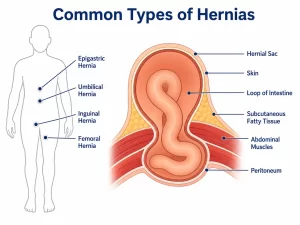
Understanding the type of hernia is essential because different types present differently, occur in different populations, and may require different surgical approaches. Inguinal Hernia (Groin Hernia): By far the most common type of hernia, accounting for approximately 75 percent of all hernia cases. An inguinal hernia occurs when a part of the intestine or fatty tissue pushes through the inguinal canal — a passage in the groin area through which the spermatic cord passes in men and the round ligament passes in women. Inguinal hernias are far more common in men than women, largely due to anatomical differences. Men are approximately 10 times more likely to develop an inguinal hernia. They present as a bulge in the groin that may extend into the scrotum in men, and often cause a dragging discomfort or ache particularly after prolonged standing or physical activity. Femoral Hernia: Less common than inguinal hernias but more common in women, particularly older women. A femoral hernia occurs just below the inguinal ligament, where the femoral canal passes from the abdomen into the thigh. Femoral hernias are smaller but carry a higher risk of strangulation than inguinal hernias and should be repaired promptly after diagnosis. Umbilical Hernia: Occurs when tissue pushes through the abdominal wall near the navel (belly button). Umbilical hernias are extremely common in newborns — most close on their own by the age of two. In adults, they typically develop due to increased intra-abdominal pressure from obesity, multiple pregnancies, chronic cough, or ascites (fluid in the abdomen). Adult umbilical hernias do not resolve on their own and require surgical repair. Incisional Hernia: Develops through the scar of a previous abdominal surgical incision. When an abdominal wound heals, the resulting scar tissue is structurally weaker than the original muscle wall — making it susceptible to hernia formation, particularly when intra-abdominal pressure is elevated. Incisional hernias can develop months or even years after the original surgery. They can range from small and asymptomatic to very large and complex. Hiatus Hernia: A hiatus hernia is unique in that it occurs internally — inside the chest cavity rather than through the abdominal wall skin. It occurs when part of the stomach pushes upward through the diaphragm into the chest cavity through an opening called the hiatus. Hiatus hernias are a major contributing factor to GERD (acid reflux) and are extremely common in adults above 50 and in those who are obese. Small hiatus hernias are often managed medically. Large or symptomatic ones may require surgical repair. Epigastric Hernia: Occurs through a weakness in the midline of the abdomen between the navel and the breastbone. Usually contains fat rather than intestinal tissue. Often small and may cause localised tenderness or a visible lump. Spigelian Hernia: A relatively rare type that occurs along the outer edge of the rectus abdominis muscle — the muscle running vertically down the centre of the abdomen. Spigelian hernias can be difficult to diagnose clinically as they are often hidden beneath the surface without a visible external bulge and may require imaging for confirmation.

What Causes a Hernia?

A hernia develops from a combination of two factors: a weakness or defect in the muscle or connective tissue wall, and increased pressure within the abdomen that pushes tissue through that weakness. Congenital weakness: Some people are born with a naturally weaker abdominal wall at certain points. This is the most common underlying cause of inguinal hernias in men — a residual weakness from fetal development that never fully closed. Ageing: Muscles and connective tissue naturally lose strength and elasticity with age, making hernias more likely in middle-aged and older adults. Chronic straining during bowel movements: Constipation and the repeated effort of straining to pass stools is a significant risk factor — particularly for inguinal and umbilical hernias. Heavy lifting: Lifting heavy weights — particularly with poor technique — generates sudden, intense spikes in intra-abdominal pressure that can trigger hernia formation at a pre-existing weak point. Chronic cough: Conditions that cause persistent coughing — including asthma, chronic bronchitis, and smoking-related lung disease — repeatedly increase abdominal pressure and are a well-recognised hernia risk factor. Obesity: Excess body weight places constant, elevated pressure on the abdominal wall, weakening it progressively over time. Previous abdominal surgery: As explained above, surgical scars are structurally weaker than original tissue and are susceptible to incisional hernia development. Pregnancy: Multiple pregnancies stretch and weaken the abdominal wall muscles significantly, increasing the risk of umbilical and other ventral hernias. Ascites: Abnormal accumulation of fluid in the abdominal cavity, often associated with liver disease, creates massively elevated intra-abdominal pressure and commonly leads to umbilical hernia development.

Symptoms of a Hernia — What to Look and Feel For

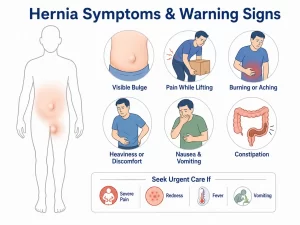
The symptoms of a hernia vary depending on its type, location, and size — but the most consistent finding across all types is a visible or palpable bulge. Visible bulge or lump: The most obvious and defining sign of most hernias. The bulge typically appears when you stand up, cough, sneeze, or strain — and may partially or fully disappear when you lie down. Over time, as the hernia enlarges, the bulge may become permanently visible even at rest. Aching, dragging, or heavy sensation: A dull ache, heaviness, or dragging discomfort in the area of the hernia — particularly after prolonged standing, walking, or physical activity. This sensation is caused by the weight of the herniated tissue pulling against the surrounding muscle wall. Sharp pain during exertion: Pain or discomfort when bending over, coughing, lifting, or straining. In early-stage hernias, this may be the only symptom. Scrotal swelling in men: In inguinal hernias that extend into the scrotum, there may be noticeable swelling and dragging pain in one side of the scrotum. This can sometimes be mistaken for a scrotal condition. Symptoms of obstruction: When the intestine is trapped in the hernia and partially blocked, symptoms include nausea, vomiting, abdominal distension, inability to pass gas or stools, and cramping abdominal pain. This is a warning sign requiring urgent medical evaluation. Symptoms of strangulation — a medical emergency: Strangulation occurs when the herniated tissue becomes so tightly trapped that its blood supply is completely cut off. Symptoms include sudden, severe pain at the hernia site, a bulge that becomes hard, red, and tender, fever, nausea, and vomiting. Strangulated hernias are surgical emergencies — if not treated within hours, the affected tissue begins to die and the situation becomes life-threatening. Any hernia patient experiencing sudden severe pain should go to an emergency department immediately.

Diagnosing a Hernia

In most cases, a hernia is diagnosed clinically — through a physical examination by an experienced surgeon who can feel and observe the bulge. The patient is often asked to stand up and cough, which makes the hernia more prominent and easier to assess. Ultrasound: Useful for confirming small or uncertain hernias and for assessing the contents of the hernia sac. CT scan: The most detailed imaging tool for complex hernias — particularly incisional hernias, recurrent hernias, or when multiple defects are suspected. A CT scan provides the surgeon with a precise map of the hernia anatomy before planning the repair. MRI: Used in selected cases where soft tissue detail is particularly important for surgical planning.

Treatment — Why Surgery is the Only Definitive Solution

This is a point worth stating clearly: there is no medication, no exercise programme, no truss or belt, and no dietary change that can repair a hernia. The only definitive treatment for a hernia is surgery. Trusses and support belts can manage symptoms temporarily in patients who are unfit for surgery, but they do not treat the hernia and carry the risk of masking the symptoms of a developing strangulation. The goal of hernia surgery is to return the herniated tissue to its proper position and repair the weakness in the abdominal wall — either with sutures alone or, more commonly in modern practice, by reinforcing the repair with a surgical mesh that significantly reduces the risk of recurrence. Open hernia repair: The traditional approach, performed through a single larger incision over the hernia site. Still widely used and highly effective for many hernia types. Recovery typically takes 3 to 6 weeks for full return to normal activity.   hernia treatment

Laparoscopic hernia repair — the modern gold standard:

Laparoscopic hernia repair has transformed hernia surgery over the past two decades. Rather than a single large incision, three small incisions (typically less than 1 cm each) are made in the abdomen. A tiny camera and specialised surgical instruments are inserted, and the hernia is repaired from inside — returning the herniated tissue to its correct position and placing a surgical mesh over the defect from within to reinforce the repair. The advantages of laparoscopic hernia repair over open surgery are substantial: Significantly less post-operative pain — the internal approach avoids large muscle incisions. Much faster recovery — most patients return to light activity within 3 to 5 days and to full normal activity including light work within 1 to 2 weeks. Shorter hospital stay — typically 24 hours or less. Lower risk of wound complications and infection. Better visualisation — the camera provides a magnified, high-definition view of the hernia and surrounding structures, allowing more precise repair. Particularly advantageous for bilateral inguinal hernias (hernias on both sides of the groin) — both can be repaired simultaneously through the same three small incisions. Lower recurrence rates when performed by an experienced laparoscopic surgeon. Dr. Hamikchandra Patel performs advanced laparoscopic hernia repair — including TEP (Totally Extraperitoneal) and TAPP (Transabdominal Preperitoneal) techniques for inguinal and femoral hernias, and laparoscopic ventral hernia repair for umbilical and incisional hernias — at Shaleen Multi Speciality Hospital, Sola, Ahmedabad.

Who Should Have Their Hernia Repaired — and When?

The general principle is that all symptomatic hernias should be repaired, and sooner is better than later. A hernia that is causing pain, discomfort, or activity limitation should be repaired without significant delay. Waiting allows the hernia to enlarge, makes repair more complex, and increases the risk of serious complications. For truly asymptomatic hernias — particularly small inguinal hernias in men — some surgeons recommend watchful waiting with regular monitoring. However, studies show that the majority of asymptomatic inguinal hernias become symptomatic within five years, and emergency repair of a strangulated hernia carries significantly higher risks than elective repair. Most experienced surgeons therefore recommend elective repair for all confirmed hernias in patients who are medically fit for surgery. Femoral hernias and incisional hernias carry higher strangulation risks and should be repaired promptly regardless of symptoms.

Conclusion

A hernia is not an emergency you need to panic about — but it is a condition that demands attention and action. Ignoring a hernia does not make it go away. It makes it larger, more symptomatic, and increasingly risky. The window between a straightforward elective repair and a dangerous emergency operation is something no patient should gamble with. Modern laparoscopic hernia surgery has made hernia repair safer, faster, and far less disruptive to daily life than it has ever been before. With the right surgeon and the right technique, most patients are back to normal within a week. Dr. Hamikchandra Patel is a Fellowship-trained laparoscopic surgeon at Shaleen Multi Speciality Hospital, Sola, Ahmedabad, with extensive experience in advanced laparoscopic hernia repair for all hernia types. If you have noticed a bulge, experienced groin or abdominal discomfort, or have been told you have a hernia and are unsure about your next step — a consultation is all it takes to get clarity. To book your appointment with Dr. Hamikchandra Patel, visit drgastro.in or contact Shaleen Multi Speciality Hospital, Sola, Ahmedabad today.
Read more...